皆さんは敢えて☆2つのレストランに行ったり商品を買ったりしたいと思いますか?

これは食べログやAmazonなどの口コミのことです。

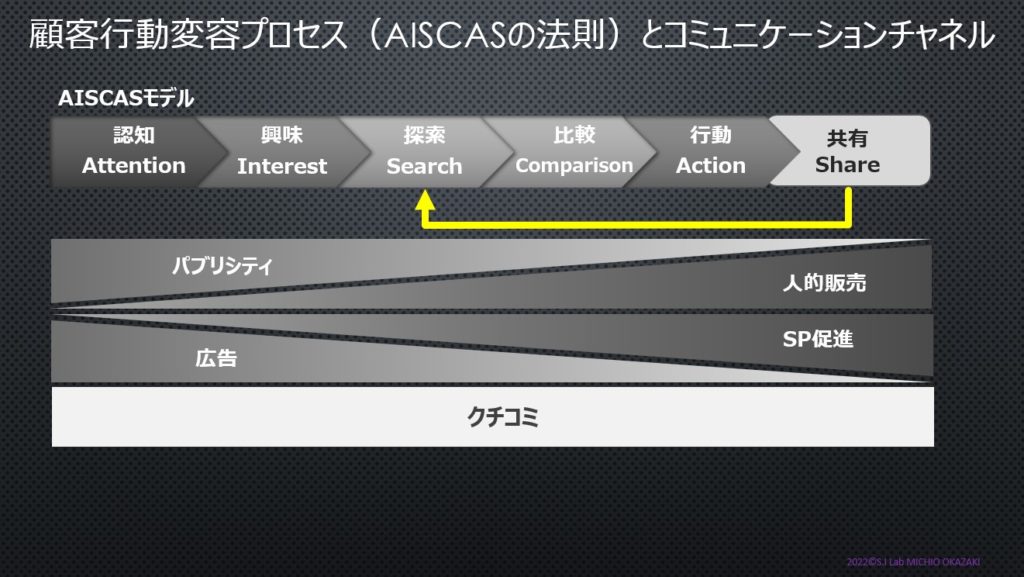
顧客の購買行動を促すには、広告やパブリシティ、セールスプロモーションなど、いくつかの効果的な方法がありますが、全てのフェーズでその効果があるのは実は口コミです。

行ってみないと分からない、使ってみないと分からない、納品されるまで分からないような、店、サービス、商品、ソリューションなどは口コミを頼らざるを得ません。

インターネットが普及した現代では、口コミの影響力は格段に強まっています。

MEO/SEOの対策は、競合が存在するビジネスにおいて顧客に自社を選択させるためには不可欠になっています。

私が顧問をさせていただいてる医療法人でも実施していますが、確実に効果があります。

もはやMEO/SEO対策をやるかやらないかではなく、やって当然、やった上でさらに競合を上回る必要があります。

この傾向を決して良いとは思いませんが、降りられないチキンレースのようなもので、やらなければ一人負けが確定です。

そして最も怖いことは、MEO/SEOサービスを提供する業者が存在するように、口コミは作為的にコントロール出来るということです。

余談ですが、

先日、あまりにも酷い対応があったので、興味もありGoogleの口コミに書き込みをしてみたところ、あっという間に0.4ポイント下がりました。

これが呼び水になったのか、潜在的な不満が噴出して同様な書き込みが増え、さらに「イイね」が押されるために常に上位に表示される悪循環を生んでいます。

口コミは高評価も大切ですが、悪い評価を受けないことも大切だと、同じくビジネスを行う者として改めて痛感したところです。

“The Terrifying Impact of Reviews: The Power of Word of Mouth”

Would you willingly visit a restaurant with just a two-star rating or buy a product with a low customer review on platforms like Yelp or Amazon? This is the world of customer reviews we’re talking about.

While there are several effective ways to influence customer purchasing behavior, such as advertising, publicity, and sales promotions, the most impactful method across all phases is, in fact, customer reviews.

For businesses, relying on reviews becomes inevitable for places, services, products, or solutions that are hard to evaluate without experiencing them firsthand, be it dining at a restaurant, using a service, or receiving a product.

In the modern era of widespread internet usage, the influence of customer reviews has significantly grown. SEO/SEM strategies have become essential for businesses in competitive markets to ensure customers choose their offerings.

I have implemented these strategies for a medical corporation I advise, and they have proven to be highly effective. It’s no longer a matter of whether to engage in SEO/SEM but a necessity to not only do it but also outperform your competitors.

This trend isn’t necessarily a positive one, resembling an unwinnable chicken race where not participating is a guaranteed loss. What’s even scarier is that, just as there are SEO/SEM service providers, there are entities capable of artificially controlling customer reviews.

As a side note, I recently had such a terrible experience that I left a negative Google review out of curiosity. Surprisingly, the business’s rating dropped by 0.4 points almost immediately. This triggered more negative reviews, as latent dissatisfaction surfaced, perpetuating a vicious cycle as more “dislikes” were given, pushing the review to the top.

While positive reviews are crucial, I’ve once again realized, as a fellow business operator, the importance of avoiding negative reviews. 
親ロシア派とウクライナ政府との間で起きているウクライナ紛争、中国の統治強化に対する香港の政治的な分断、2020年の大統領結果に端を発するアメリカの共和党と民主党との政治的な分断、ミャンマーの軍事クーデターによる政治的危機など、世界中で分断が起きています。

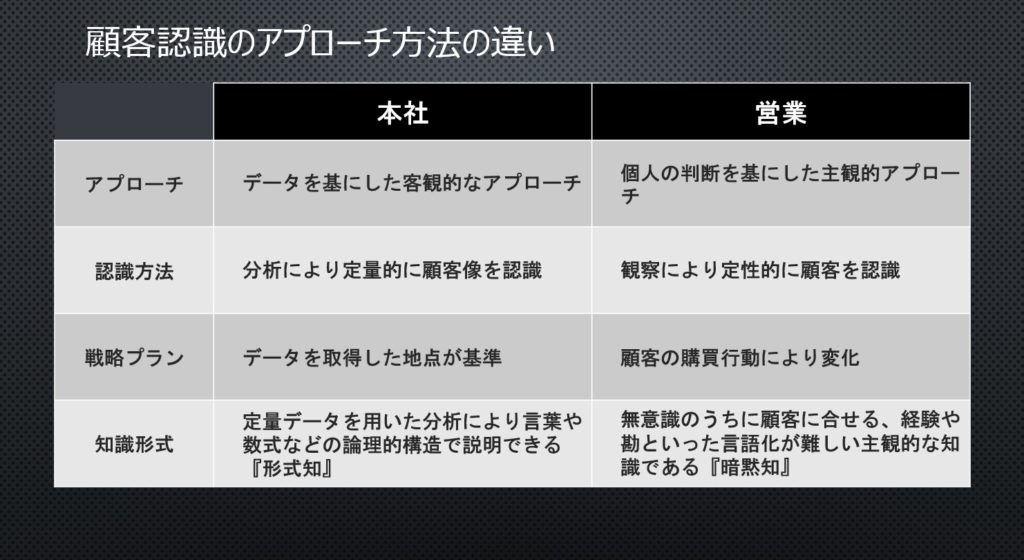
会社組織においても、本社部門と営業活動での対立は永遠の課題です。

コミュニケーションの分断を解決するのは言語による話し合いだけです。

しかし、定量データを用いた分析により、言葉や数式などの論理的構造で説明できる『形式知』を用いる本社部門と、無意識のうちに顧客に合せる、経験や勘といった言語化が難しい主観的な知識である『暗黙知』を用いる営業部門では、使用する言語が異なります。

データを取得した地点を基準として戦略プランニングを行う本社部門と、目の前で常に購買行動を変化させる顧客に合わせて、戦略プランを変化させる必要がある営業部門とでは、メリーゴーランドとジェットコースター程のスピード感の違いが生じます。

VUCAの時代と呼ばれる現在の外部環境は、変化のスピードが速く、予測不能です。

戦略プランは常に外部環境要因の影響を受けており、相対的に決める必要があります。

外部環境要因をより細分化したものが、地域戦略であり、営業部門が対面する顧客です。

短いサイクルで更新される市場/顧客、競合データと、その分析手法を共通言語化する必要があります。

“Why Do Headquarters and Sales Teams Often Clash: Bridging the Gap”

The conflict in Ukraine between pro-Russian factions and the Ukrainian government, the political division in Hong Kong over China’s tightening of governance, the political division between the Republican and Democratic parties in the United States stemming from the 2020 presidential results, and Myanmar. The world is divided, such as the political crisis caused by the military coup d’état.

Conflicts between the head office department and sales activities are also an eternal problem in a company organization.

Only language discussion can solve the communication divide.

However, through analysis using quantitative data, there are head office departments that use “explicit knowledge” that can be explained using logical structures such as words and mathematical formulas, and subjective knowledge that is difficult to verbalize, such as experience and intuition, that unconsciously adapts to the customer’s needs. The language used in the sales department, which uses “tacit knowledge” as knowledge, is different.

The head office department, which conducts strategic planning based on the point at which data was acquired, and the sales department, which must change its strategic plan in line with customers who constantly change their purchasing behavior right in front of their eyes, are on a merry-go-round and a roller coaster. There will be a difference in speed.

The current external environment, called the age of VUCA, changes rapidly and is unpredictable.

Strategic plans are always affected by external environmental factors and must be determined relatively.

Regional strategies and customers that the sales department faces are a more detailed segmentation of external environmental factors.

It is necessary to standardize the market/customer and competitive data, which are updated in a short cycle, and their analysis methods.

ビジネスモデルには全く異なる2つの種類があります。

一つは潜在顧客を対象とした新規市場の開拓と、そしてもう一つは顕在顧客を対象とした市場占有率の向上です。

新規市場の開拓はブルーオーシャンマーケット、市場占有率の向上はレッドオーシャンマーケットが主戦場です。

主戦場には適した、戦略/マーケティングプロセスがあります。

#ビジネスモデル #ブルーオーシャン #レッドオーシャン

“Two Different Strategies/Marketing Processes Based on Business Models”

There are two distinct types of business models, each requiring a unique approach:

One focuses on exploring new markets to target potential customers, while the other centers around increasing market share among existing customers.

Expanding into new markets is the realm of the Blue Ocean Strategy, while improving market share is the domain of the Red Ocean Strategy.

Each of these battlegrounds demands tailored strategies and marketing processes. 

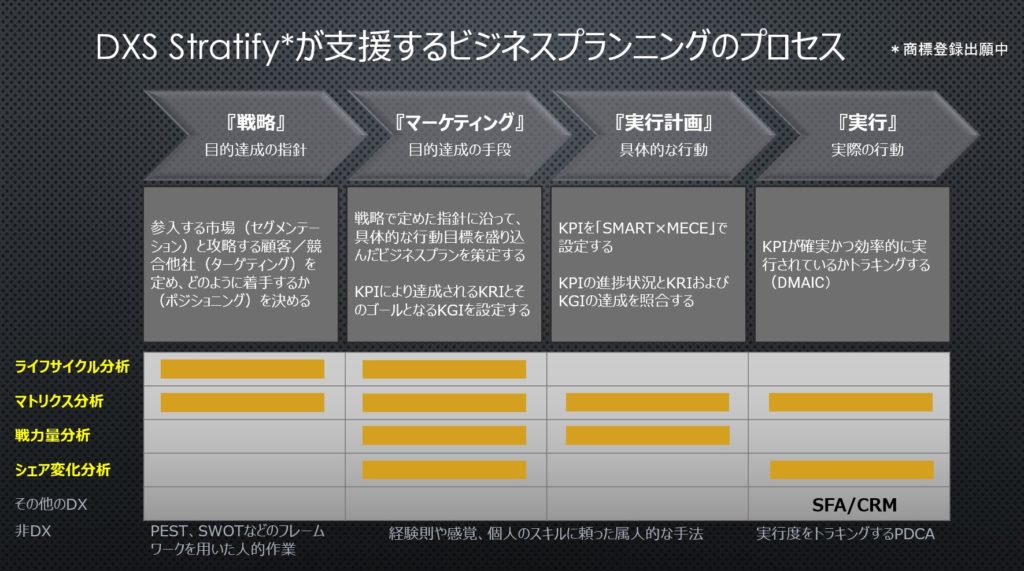
営業支援アプリDXS Stratify*がもつ4つの分析機能が、ビジネスプランニングの4つのプロセスのうち、どこを支援するのかダイアグラムにしてみました。

*商標登録申請中

“Business Planning Process Assisted by DXS Stratify”

I made a diagram showing which of the four business planning processes the four analysis functions of the sales support app DXS Stratify support.

IT技術の進歩により、戦略/マーケティングの世界にもDX化の波が押し寄せています。

DX化によってビッグデータを扱えるようになり、従来では解像度の限界であった属性分類された顧客の単位が、顧客からさらに個客単位にまで粒度が小さくなっています。

マーケティングオートメーションを活用すれば、顧客の属性分類などしなくとも、受注確率の高い顧客を抽出することが出来ます。

一方、人的作業で行っていた、従来型のビジネスフレームワークなどを用いる古典的手法は、デジタルとの親和性が低く、客観性や再現性に乏しいスピード感の低い手法です。

人の手による戦略/マーケティングプランニングは、全てのソリューションをデジタル化し連携するための阻害要因です。

では人的作業による古典的手法はその役割を終えたのかといえばそうではありません。

デジタルによる戦略/マーケティングプランニングは既存データを用いるために、顕在化した事象に対しては優れていても潜在的な市場を開拓することは苦手です。

個客単位まで細分化することが出来るということは、言い換えれば非常に小さな市場になるため、ニッチ型のビジネスに向かいうことになります。

顕在化していない、新たな潜在的な市場を開拓することが出来ればビッグビジネスにつながり、ゲームチェンジャーにだってなる可能性があるのです。

古典的手法による戦略/マーケティングプランニングのカリキュラムを考えてみました。

一般的にSWOT分析は強みと弱みの両側面から4象限分析を行いますが、ワークショップではイノベーションを意識して、「自社の強み」、それも「自社だけの強み」にスコープしています。

チームメンバーとのワークショップを通じてイノベーションを巻き起こすかもしれません。

Has the Classic Strategy/Marketing Planning Process Served Its Roles?

The world of strategy and marketing is experiencing a wave of digital transformation (DX) propelled by advancements in IT technology.

Thanks to DX, the ability to handle big data has grown, and what was once a limited categorization of customer attributes has now become more granular, down to the individual customer level.

By leveraging marketing automation, it’s possible to extract high-conversion-probability customers without the need for extensive customer attribute classification.

On the other hand, the classical method that uses a conventional business framework, etc., which has been done manually, has a low affinity with digital, and is a slow method that lacks objectivity and reproducibility.

Human-led strategy and marketing planning can be a hindrance to digitizing and integrating all solutions.

So, does this mean that traditional methods reliant on human effort have outlived their roles? Not necessarily.

Digital strategy and marketing planning excel when using existing data but struggle when it comes to exploring latent markets or potential opportunities.

The ability to segment down to the individual customer level implies very niche markets. However, tapping into undiscovered, latent markets has the potential to lead to significant business growth and even become a game-changer.

I consided a curriculum for strategy and marketing planning using traditional methods.

In general, SWOT analysis is a four-quadrant analysis from both sides of strengths and weaknesses, but in the workshop, we are conscious of innovation and scope it to “our company’s strengths” and “our company’s unique strengths”.

Through workshops with team members, this approach might just ignite innovation.

In conclusion, while digitalization has brought about tremendous change in the strategy and marketing landscape, traditional methods still have a role to play, particularly in fostering innovation by focusing on a company’s distinct strengths.

複数ある各プロダクトチームから、ダイレクトにビジネスプランが営業部門に落とされることには問題があります。

プロダクトごとの活動優先順位が交通整理をされないままでは、営業現場の混乱を引き起こします。

各プロダクトチームは担当製品の目標達成のために必要十分なリソース量を課してきますが、営業も人の子、活動量には限界があります。

結果、全てが中途半端に終わることになります。

市場環境は営業担当者ごとに異なるため、標準化された分析の方法が必要です。

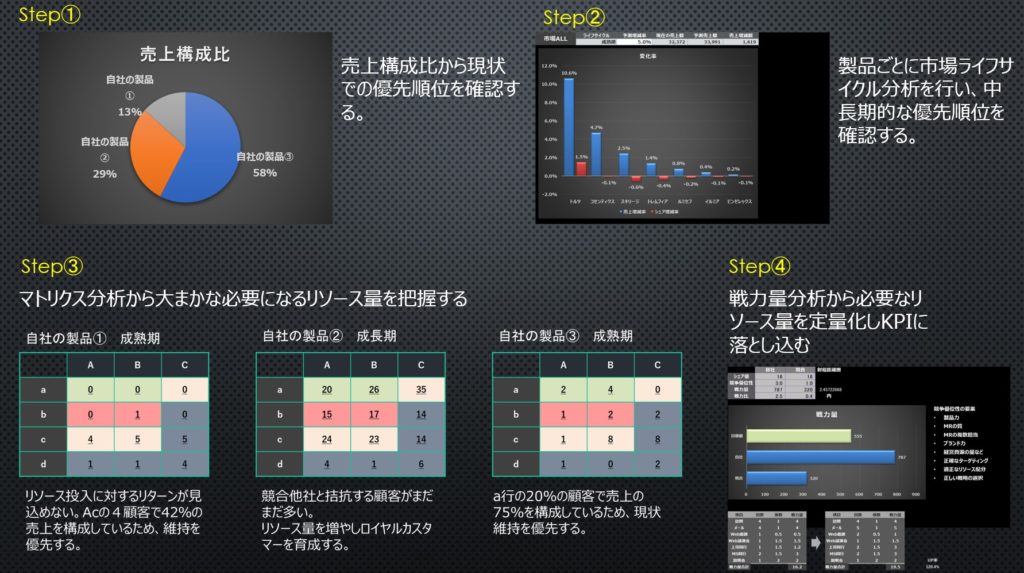
市場ライフサイクル分析とマトリクス分析、そして戦力量分析を用いた、リソースアロケーションの方法を4つのStepで行ってみました。

これによりリソース量をKPIとして数値化することが出来ます。

注意すべきは、KPIは達成すべきゴールではなく、行動の指標だということです。

KPIは、KRIそして最終的にはKGIを達成するための手段であることを忘れて、手段を目的化しないことです。

強化、縮小、維持、撤退

この4つの基本戦略に沿って、リソース配分を決定します。

リソースの総量は企業ごとの経営資源の量により決まります。

そのため、経営資源に優る大手が戦力的に有利となりますが、中小企業であっても市場細分化を行ない、4つの基本戦略によりリソースを集中投下することで競争優位を築くことは可能です。

“How to Determine Resource Allocation for Multiple In-House Products”

Directly passing business plans from multiple product teams to the sales department can pose significant challenges.

Without proper prioritization of activities for each product, it can lead to chaos in the sales field.

While each product team allocates resources as needed to achieve their product’s goals, the capacity for sales activities has its limits.

As a result, everything ends up being half-baked.

Because market conditions vary for each sales representative, standardized analytical methods are essential.

In this article, we explore a four-step approach to resource allocation using Market Lifecycle Analysis, Matrix Analysis, and Force Capacity Analysis. This allows us to quantify resource levels as Key Performance Indicators (KPIs).

It’s important to note that KPIs are not the goals to be achieved but rather indicators of actions taken.

Remember that KPIs are a means to achieve Key Results Indicators (KRIs) and ultimately, Key Goal Indicators (KGIs). Don’t lose sight of the fact that they are a means to an end, not an end in themselves.

Strengthen, reduce, maintain, withdraw

Determine resource allocation according to these four basic strategies.

The total amount of resources is determined by the amount of management resources for each company.

For this reason, large companies with superior management resources have a competitive advantage, but even small and medium-sized companies can establish a competitive advantage by segmenting their markets and concentrating their resources on four basic strategies.