
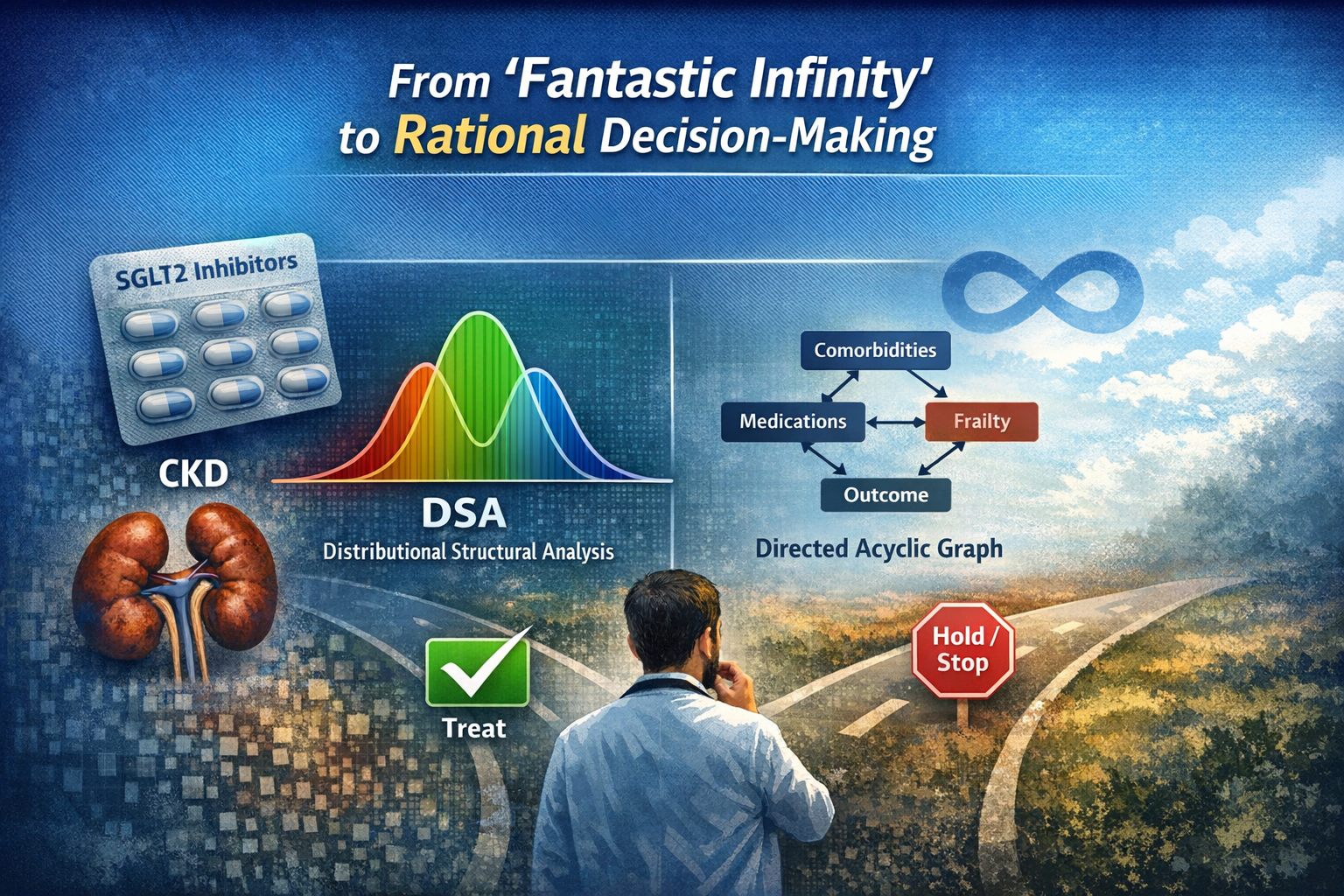
A recent meta-analysis confirms that SGLT2 inhibitors offer broad renal benefits across diverse patient groups, yet this very success complicates clinical choices by encouraging the over-prescription of multiple medications. While traditional statistical averages prove a drug’s general efficacy, they often obscure individual risks and the specific boundaries where a treatment might become counterproductive. To address this, the text proposes integrating Distributional Structural Analysis (DSA) to visualize how treatment responses vary across a population beyond a simple mean. Furthermore, using Directed Acyclic Graphs (DAGs) can map the causal pathways behind these variations, transforming intuitive clinical judgment into a rigorous, explainable framework. This combined approach allows doctors to prioritize treatments effectively and identify when to withhold therapy, moving past generic guidelines toward a more transparent and individualized decision-making process.

*ミュートしています
現代の科学界ではビッグデータ化と統計手法が高度化する反面、論文の約半数に誤りがあるとされる「再現性の危機」が深刻な問題となっています。この課題を解決するために開発されたDSA+DAG分析モジュールは、因果関係を可視化し、適切な分析モデルを自動で導き出す画期的なシステムです。本ツールは、研究者が陥りやすい不適切な変数選択やバイアスをアルゴリズムによって防ぎ、解析の妥当性を理論的に保証します。さらに、統計的な根拠を自動生成することで査読対応を円滑にし、研究者が本来の目的である真理の探究に集中できる環境を提供します。複雑なデータ解析を自動化するこのエンジンは、研究プロセスを劇的に効率化する次世代のソリューションです。