新規クリニック開業を検討しています。

開業するにはまず立地、医療圏が重要ですが、そうそう掘り出し物件がみつかるもではありませんし、そもそも良い物件とは何かを定義したうえで探す必要があります。

良い物件とは戦略上の要件を満たした物件です。

戦略とは主戦場をどこにして、誰を対象に、どのような立ち位置であるかを決めることです。

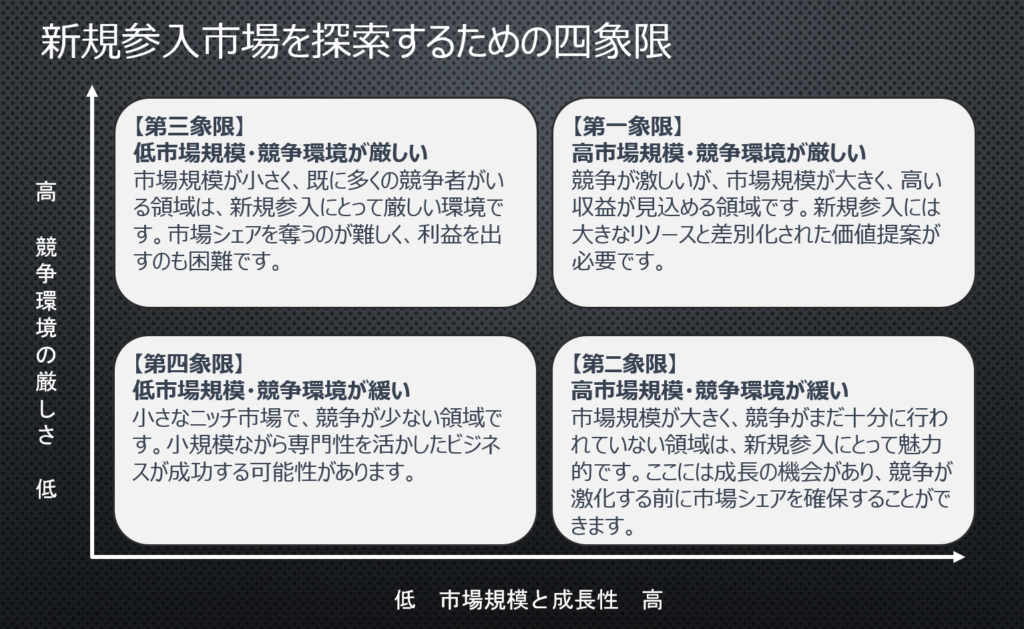
市場の規模と競争環境の2軸で四象限を作ってみました。

理想的なフレームは、市場の規模が大きくかつ成長性が見込めて、競争環境が緩い、あるいは自社の競争優位性が高いフレームです。

四象限では第二象限に該当します。

第一象限に参入する場合には、競合を上回る経営資源の投入が必要になります。

市場分析の結果をマトリクス表として可視化したものは数多くあります。

S.I Labのマトリクス分析が特許を取得した際も、一度は類似の先行発明があるとして特許庁より拒絶理由通知を受けています。

先行発明は百貨店のフローごとの総売上金額と製品ごとの売上高を2軸にしたものでした。

以前努めていた製薬企業でも同様に、競合を含む製品群の市場規模と自社製品の売上高による2軸を用いた顧客優先順位のターゲティングを行っていました。

しかしこの市場あるいは売上高が大きな順に優先順位付けをする、パレート分析法には大きな落し穴があります。

図に市場規模と自社製品売上の売上金額による散布図を描いてみましたが、市場規模の大小と、自社製品売上の金額の間には相関関係がありません。

すなわち、市場規模が大きなところであれば、必ずしも自社製品の売上が大きいとは限らないということです。

問題は同じセグメント分類された顧客の中に、ロイヤルカスタマーと競合との拮抗顧客、競合のロイヤルカスタマー、取引額の低い顧客が混雑してしまうことです。

これら全く戦略が異なる4タイプの顧客に対してワンオペレーションで営業アプローチをすることになるため、成果が得られないだけではなく、経営資源に無駄が生じてしまいます。

医薬品販売データの最大の価値は競合製品の情報が含まれた3Cデータということです。

3Cデータであることで競争地位と競争優位性の軸を用いてマトリクス表示が可能になります。

“S.I Lab’s Matrix Analysis Sets It Apart”

There are numerous visual representations of market analysis results in the form of matrix tables. When S.I Lab obtained a patent for its matrix analysis, it faced a rejection notice from the patent office, citing the existence of prior art with similarities.

The prior art involved using a two-axis system, one representing the total sales for each department in a department store, and the other showing the sales of individual products.

Similarly, at a pharmaceutical company I worked for, market size, including competitors, and the sales figures of their own products were used on a two-axis system to prioritize customer targeting.

However, prioritizing based on market size or sales figures has significant pitfalls. When plotting a scatter diagram with market size and the sales amount of their products, there was no correlation between the two.

In other words, having a large market size did not necessarily mean having a large sales figure for their products.

The problem arises when customers in the same segment are a mix of loyal customers, customers in competition with other companies, loyal customers of competitors, and customers with low transaction amounts.

Attempting to use a one-size-fits-all approach for these four distinct types of customers not only leads to poor results but also wastes valuable resources.

The greatest value in pharmaceutical sales data lies in the inclusion of information about competitor products, referred to as 3C data.

By utilizing the axes of competitive position and competitive advantage made possible through 3C data, matrix representation can be effectively employed.

マトリクス分析法は、縦4×横3の12個のマトリクスフレームで構成されています。

縦横の軸にはそれぞれ市場シェア理論に基づく計算式からなるアルゴリズムが組み込まれています。

同じくシェア理論に基づき、ライフサイクル分析、戦力量分析、シェア変化分析も構築されており、そのため一貫した分析結果が得られます。

クライアントから、市場の規模、競合の数などを理由に、マトリクス分析の軸を任意の数値に変更したい、または4×4のマトリクスにしたいという要望を受けることがあります。

では任意に変更したその数値はどのような根拠に基づいたものでしょうか?また、誰もが納得する客観性や結果につながる重要な再現性を担保しているでしょうか?

一貫性と信頼性のある結果を得るためには安易に分析手法を変えるべきではありません。

もし自社と市場環境に応じたアレンジをしたければ、自社がNo,1を目指す市場に用いるデータを変えるべきです。

例えば抗アレルギー剤市場は先発後発、AGなどが数多く入り乱れ、全ての製品のシェアが10%に満たないような拮抗市場です。

そのため、全体市場のデータを基に分析を行っても粒度の荒い分析結果となってしまいます。

先発医薬品市場でNo,1を目指すのか、上位10品目の中でNo,1を目指すのか、同じ作用機序の薬剤の中でNo,1を目指すのか、企業の市場戦略に拠り分析するデータの選択や加工をする必要があります。

分析手法を頻繁に変えすぎることは混乱や目的を見失うリスクを伴います。

目的に応じた適切な分析手法を選択し、それを一貫して実施することが大切です。

“Changing the Data, Not the Analysis Method, is What Should Be Altered”

Matrix analysis is structured around 12 matrix frames, with a 4×3 configuration.

Both vertical and horizontal axes incorporate algorithms based on market share theory.

Life cycle analysis, strength analysis, and share change analysis are also built based on the same market share theory, which allows consistent analysis results to be obtained.

We sometimes receive requests from clients to change the axis of matrix analysis to arbitrary numbers, or to use a 4×4 matrix, due to market size, number of competitors, etc.

But what serves as the basis for these arbitrary numerical changes? And are they guaranteed to provide objectivity and results that everyone can agree on, ensuring critical reproducibility?

To obtain consistent and reliable results, it is not advisable to change the analysis method too readily.

If you desire adjustments that align with your company’s goals and market conditions, consider changing the data you use in the market you aim to be number one in.

For instance, the allergy medication market is highly competitive, with a mix of branded and generic products, none of which individually capture more than 10% of the market share.

Consequently, conducting analyses based on overall market data would yield results of limited granularity.

Depending on whether your goal is to be number one in the branded pharmaceutical market, to be number one among the top 10 products, or to be number one among drugs with the same mode of action, you need to choose and process the data to analyze based on your company’s market strategy.

Changing the analysis method too frequently carries the risk of confusion and losing sight of your objectives.

It is crucial to choose the appropriate analysis method that aligns with your goals and to consistently implement it. 

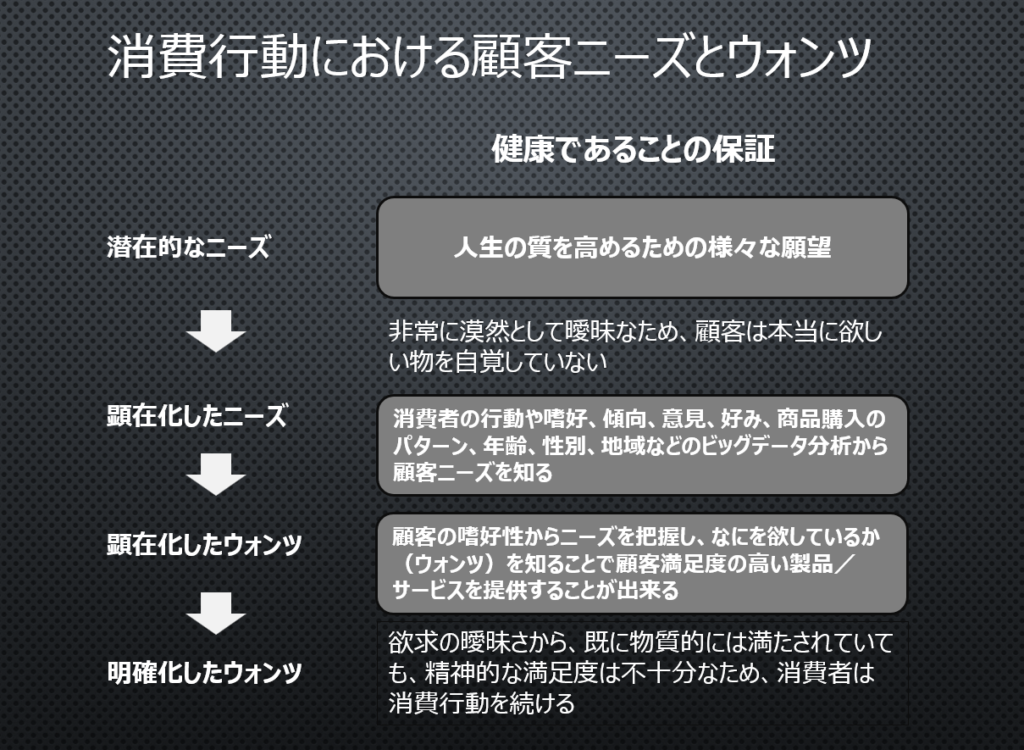
ニーズとは曖昧で漠然としたものであり、多くの場合で顧客本人も自分が欲しいモノを明確に認識できていません。

「もし顧客に、彼らの望むものを聞いていたら、彼らはもっと速い馬が欲しいと答えていただろう。」/ヘンリーフォード
「多くの場合、人は形にして見せて貰うまで自分は何が欲しいのかわからないものだ」/スティーブ・ジョブズ

すなわち、ニーズが多様化したのではなく、本来ニーズは多様性を有するものであり、現代ではそれらにアクセスしやすくなったことが多様化の感覚を強化しています。

これは、グローバル化、デジタルテクノロジー、情報の普及、競争の激化などが影響しています。

多様性は本質的なものであり、欲求には際限がありません。

顧客の異なる要求全てに対応することは不可能であり、企業は適切な戦略を採用すべきです。

“Are Customer Needs Diversifying?”

The concept of “needs” is often ambiguous and vague, and in many cases, even customers themselves may not have a clear understanding of what they want.

“If I had asked people what they wanted, they would have said faster horses.” – Henry Ford
“In most cases, people don’t know what they want until you show it to them.” – Steve Jobs

In other words, it’s not that customer needs have diversified, but rather that needs inherently possess diversity, and in the modern era, it has become easier to access them, creating a heightened sense of diversification.

This diversification is influenced by factors such as globalization, digital technology, widespread information, and intensified competition.

Diversity is essential and desire is limitless.
It’s impossible for companies to cater to all of their customers’ diverse demands, and therefore, they should adopt appropriate strategies.