I often use the term “competitive advantage,” but let’s take a moment to reexamine its meaning.
In essence, it refers to a company’s ability to consistently outperform its competitors in a competitive environment.
In today’s increasingly challenging business landscape, there is no room for complacency, and failure should not be taken lightly as a mere learning experience for the next attempt.
Once a company fails, it becomes exceedingly difficult to make a comeback in the same market. If a company that on the verge of winning or losing in a competitive state is kicked out of the market, it becomes nearly impossible to revive unless significant innovations take place.
To establish an absolute competitive advantage over rival companies, it is crucial for a company to possess unique know-how and expertise that sets it apart from others.
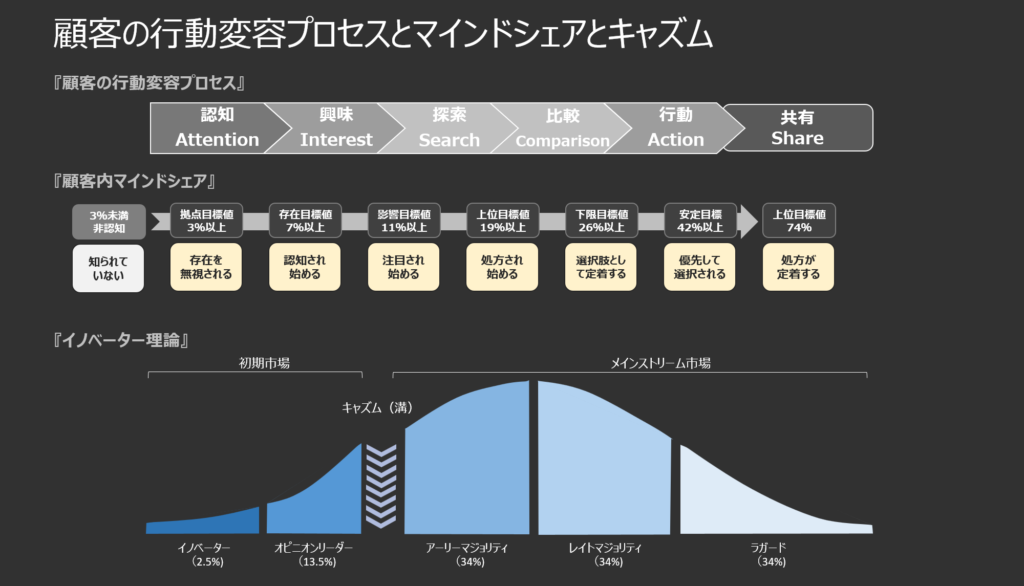
“Why is the new product launch stuck in a chasm and unable to break free?”
With a new product launch, a promotional campaign is rolled out, and the account openings seem to be going smoothly. However, it’s not uncommon to experience the frustration of seeing sales, which were initially expected to grow steadily, start to plateau.
This situation often arises when the account openings are tied to incentives for pharmaceutical wholesalers. One of the key contributing factors is the lack of customer focus. While the products are indeed delivered to customers, there is a notable absence of prescriptions being issued, and it is not unusual for returns to occur after a certain period.
The reason for this can be boiled down to one simple factor – while there may be quantitative recognition of customer profiles based on sales data, there is a failure to qualitatively understand customers through observation and subjective approaches that adapt to individual customer behavior changes.
Customers say they will prescribe if there is a suitable patient, the lack of a well-defined next step hampers the process of guiding behavioral change. As a result, the product ends up being prescribed mainly to highly motivated customers, while other potential customers are not sufficiently nurtured.
This challenge becomes even more pronounced in today’s business environment, where information channels have transitioned into digital platforms. Understanding customers’ behavior change, or in other words, their treatment preferences and prescription tendencies, is crucial based on the existing product’s status.
Even if the new product belongs to an entirely new class of medication, this principle applies if the target patients are already undergoing some form of treatment. Understanding customers’ treatment preferences and prescription tendencies, who are the physicians in this case, can be achieved through pharmaceutical sales data.
We show the customer mindshare value as a way to quantify the customer behavior change phase.