
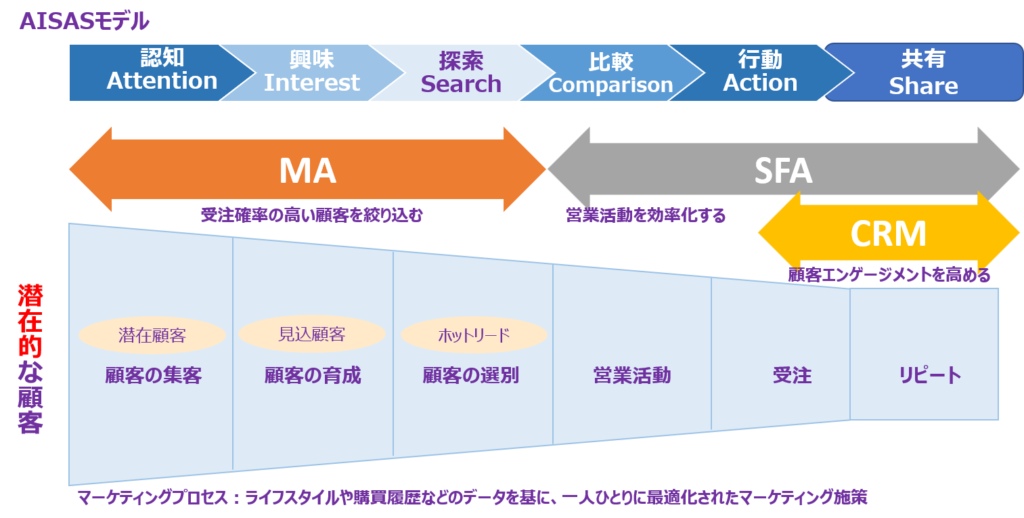
「CRMだけでは、顧客を直接的に購買に向かわせることはできない」

なぜならCRMは主に、既存顧客との関係を強化し、顧客エンゲージメントを高めるために活用されるものだからです。

使用に処方箋を必要とする医療用医薬品ビジネスは、予めターゲット顧客が明確な1on 1マーケティングです。

そのため、ターゲット顧客は全てが処方意欲の高い顧客とは限らず、マスマーケティングのように抽出された受注確率高い顧客に対してCRMが用いられるビジネスモデルとは異にします。

そのために期待した売上インパクト得られません。

戦略に基づき、優先すべきターゲット顧客と、競合に対する優越性を得るためのリソースアロケーションを正しく設定し、顧客解像度を高めたうえで、活動管理と顧客管理の戦略とツールであるSFA/CRMを連動させることで、効率良く顧客を購買に向かわせることが出来ます。

“CRM alone cannot drive customers directly to purchases.”

Because CRM is primarily used to strengthen relationships with existing customers and increase customer engagement.

The ethical drug business, which requires a prescription for use, is one-on-one marketing with a clear target customer in advance.

For this reason, not all target customers are customers who are highly motivated to prescribe, and this is different from the business model in which CRM is used for extracted customers with a high probability of receiving orders, such as mass marketing.

Therefore, the expected sales impact cannot be obtained.

Based on the strategy, correctly set the priority target customers and resource allocation to gain superiority over the competition, improve customer resolution, and link activity management and customer management strategies and tools SFA/CRM By doing so, you can efficiently direct customers to purchase.

マーケティングオートメーションの登場により、ターゲティングにおける顧客粒度は、それまでの特定の属性に分類された「顧客」から、「個客」へとより細分化ができるようになりました。

個別最適化が可能になったことから、セグメンテーションとターゲティング、そして自社のポジショニングによる属性分類である、すなわち戦略を必要としなくなりました。

マーケティングオートメーションは購買意欲の高い顧客を特定し、個別最適化された情報や特別なプロモーションの提供により個客の興味・関心を引き出し、購買へと導くことから、潜在顧客に対するマスマーケティングに対して非常に効果的です。

しかし、使用に処方箋を必要とする医療用医薬品ビジネスは、予めターゲット顧客が明確な1on 1マーケティングです。

そのため全てのターゲット顧客が処方意欲の高い顧客とは限らないために、誰でも良いから1人でも多く自社製品を購入してくれれば良いというマスマーケティングとはビジネスモデルを異にします。

医薬品ビジネスにおいては市場規模と成長性、優先顧客と自社の競争優位性を明確にするための「指針」である戦略が重要です。

また競争が一層厳しくなる縮小市場では、競合の動向を把握することで、市場のトレンドや顧客のニーズを理解し、自社の戦略を改善することができます。

顧客ごとに自社と競合全ての売上が分かる、医薬品販売データを各社が入手可能な製薬業界は、データの活用次第では優位にもリスクにもなると言えます。

“Will marketing automation make all strategies unnecessary?”

With the advent of marketing automation, the customer granularity in targeting can now be further subdivided from “customers” classified by specific attributes to “individual customers”.

Since individual optimization is now possible, segmentation, targeting, and attribute classification by company positioning, that is, strategies are no longer required.

Marketing automation identifies customers who are highly motivated to purchase, draws out the interests of individual customers by providing individually optimized information and special promotions, and leads them to be effective for make purchases.

However, the ethical drug business, which requires a prescription for use, is a one-on-one marketing with a clear target customer in advance.

For this reason, the target is not necessarily a customer with a strong desire to prescribe, so the business model is different from mass marketing.

And in a shrinking market where competition is becoming more intense, understanding the competition will help you understand market trends and customer needs, and improve your strategy.

It can be said that the pharmaceutical industry, in which each company can obtain drug sales data that shows the sales of its own company and all of its competitors for each customer, can be both advantageous and risky depending on how the data is used.

市場の大きな顧客の攻略は難しいが成功すれば大きなリターンが得られ、市場の小さな顧客の攻略は容易だが最大市場獲得の機会を損失する恐れがあると考えられることから、市場の大きな顧客を選定しリソースを集中投下することが「選択と集中」と考えるのは性急すぎます。

競合が存在する競争市場において、市場規模の一軸だけで判断することは競争優位性を得ることが出来ないだけではなく、気が付かない間に競合から攻略されてしまい市場から駆逐されてしまう恐れがあります。

市場の大きな顧客は競合が厳しいために多くのリソース量を必要とし消耗戦になりやすく、攻略に成功しても競合の参入により短期間で奪われる危険性があります。

市場の小さな顧客の攻略は競合が少なく、小さなリソース量でも攻略することが出来るため、ドミナント戦略によりシェアを積み上げることで着実に市場を拡大することが出来ます。

市場が縮小し競争環境は一層厳しさを増していることから、市場規模に自社の競争優位性を加えた二軸で顧客分類を行い、自社が持つ経営資源を考慮したうえで適切な優先順位とリソース配分を行うことが重要です。

“Do you think it’s natural to prioritize the big customers in the market to increase sales?”

Customers with large markets are difficult to capture, but if successful, large returns can be obtained. Customers with small markets are easy to capture, but there is a risk of losing the opportunity to capture the whole market. It is too hasty to think that concentrated to customers with large markets investment of resources is “selection and concentration.”

In a competitive market where there are competitors, judging only by the market scale will not only prevent you from gaining a competitive advantage, but you may also be expelled from the market by being attacked by your competitors without realizing it.

A large customer in the market requires a large amount of resources due to severe competition, and it is easy to become a battle of attrition, and even if you succeed in capturing it, there is a risk that you will be taken away in a short period of time by the entry of competitors.

There is little competition to capture customers in a small market, and it is possible to capture them with a small amount of resources, so we can steadily expand the market by accumulating market share through a dominant strategy.

Given that the market is shrinking and the competitive environment is becoming even more intense, it is necessary for you to classify customers based on a dual-axis approach, considering both market size and your company’s competitive advantages. Then, allocate appropriate prioritization and resources according to the business resources your company possesses.

営業担当者(MR)が効率よく営業売上目標(KGI)を達成することが出来るようにするために、多くの製薬企業では「KPI」を指標に用いています。

またKPIの解像度を高め効率化を図るためにSFA/CRMなどのデジタルサポートツールが普及してきました。

市場環境の多様化から、MRを単純に売上実績だけで評価することは不公平感を生むため、昨今では活動における努力を評価するプロセス評価に重点を置く製薬企業が増えており、その活動における努力を評価する指標として活動量を数値化したKPIが用いられます。

しかし医薬品ビジネスは消費材にくらべ、行動変容の変化量が大きく、そのためMRは顧客の行動変容フェーズを観察により認識し、無意識のうちに顧客に合わせています。

そのため、何回面談したから、何度説明会を実施したから売上目標が達成できるという「思考の道筋、論理」に違和感を持つことで実効性が低くなってしまいます。

これらを回避するために、中間指標として「KRI」が用いられます。

例えばKPIを実行することで、10人の顧客から、新患獲得を5例、3ヶ月連続で獲得するなどです(行動変容は必ずしも定量化出来ないため定性的指標も必要)。

MR不要論で語られるようにMRの存在が売上に寄与しない背景は、売上に直結しない評価指標が原因かもしれません。

KPIとその支援ツールであるSFA/CRMが機能するためには、正しい目標の設定と、正しいターゲット顧客の設定、そして正しいリソースアロケーションの設定が重要であることは言うまでもないでしょう。

“The KPIs that make MR activities more efficient lead to the argument that MRs are unnecessary.”

To enable sales representatives (MRs) to efficiently achieve their sales targets (KGIs), many pharmaceutical companies utilize Key Performance Indicators (KPIs) as metrics.

Furthermore, to enhance the resolution of KPIs and streamline operations, digital support tools such as SFA/CRM have become widely adopted.

Due to the diversification of the market environment, evaluating MRs solely based on sales performance creates a sense of unfairness. Therefore, pharmaceutical companies nowadays are placing more emphasis on process evaluation, which evaluates the efforts made in activities. As a metric to assess these efforts, quantified KPIs that measure activity levels are employed.

However, compared to consumables, the pharmaceutical business entails significant behavioral changes. As a result, MRs observe and unconsciously adapt to customer behavior changes. Thus, relying solely on the “train of thought and logic” that achieving sales targets is solely based on the number of visits or actions can diminish effectiveness.

To avoid these pitfalls, Key Result Indicators (KRIs) are utilized as intermediate indicators.

For example, by doing a KPI, MRs acquire 5 new patients from 10 customers for 3 consecutive months (behavior change cannot always be quantified, so qualitative indicators are also necessary).

The argument that MRs is unnecessary may stem from the fact that their presence does not directly contribute to sales, possibly due to evaluation metrics that do not directly impact sales.

It goes without saying that setting the correct goals, identifying the right target customers, and allocating resources correctly are crucial for KPIs and their supporting tool, SFA/CRM, to function effectively. 

医師支援アプリには生成AIの機能があり、必要事項を入力する事で特定の製品をリコメンドします。

医薬品は高度な情報を伴う製品であるため、これまでは情報を提供する製薬会社側が有利な不完全競争市場でした。

しかしコロナ禍で、MRによる対面での情報提供が困難となったため、各社がこぞって顧客がネット上で自社製薬の情報にアクセス出来るようにDXを推進してきました。

顧客が情報にアクセスしやすくなった結果、MRからの情報を得なくとも自分自身で比較検討し、薬剤を選択出来るようになりました。

さらに今回のような医師支援アプリが登場する事で、忙しい時間を割き、自分自身で比較検討などしなくとも、AIが薬剤選択してくれます。

優れた製品を作り情報提供を行えば売れるという、高度経済成長期のビジネスモデルを信じ続けてきた結果、製薬会社は競争市場には競合が存在することを忘れてしまったようです。

人口減少と社会保障費の抑制により、既に市場は縮小し、レース型競争市場からゲーム型競争市場へと変わっており、競争環境はより厳しくなっています。

AIの登場は、今後ますます一強型競争市場を加速させることになるでしょう。

AI Disrupting the Advantageous Imperfect Competition Market of Pharmaceutical Companies

The doctor support app featured in the article has a generative AI function that recommends specific products by inputting the necessary information.

Since pharmaceuticals are products that involve high-level information, the market has been imperfectly competitive in the past, in which the pharmaceutical companies that provide information have an advantage.

However, due to the corona crisis, it has become difficult for MRs to provide face-to-face information, so all companies have promoted DX so that customers can access information about their pharmaceuticals online.

As a result of easier access to information for customers, they are now able to make comparisons and select drugs on their own without obtaining information from MRs.

Furthermore, with the emergence of a doctor support app like this one, AI will select drugs without having to take time out of your busy schedule and compare them yourself.

As a result of continuing to believe in the business model of the period of high economic growth, where excellent products can be sold by providing information, pharmaceutical companies seem to have forgotten that competition exists in a competitive market.

The market has already shrunk due to the declining population and curtailment of social security costs, and the market has changed from a racing-type competitive market to a game-type competitive market.

In the future, AI will help the best-selling drugs sell even more.

製薬業界が求める薬価の下支えや安定供給に対する批判があります。

様々な法的な保護によって守られる医薬品業界は、護送船団方式と呼ばれることがあります。

護送船団方式(Convoy system)とは、政府が特定の産業を保護し、過度の競争を避けて産業を育成・成長させる政策のことです。

市場確保、価格競争、競合参入などの保護は他の業界に比べて、確かに過保護のように見えます。

多くの製薬企業の業績を悪化させている要因となっている特許切れも予め予見可能であり、必ずしも不可避ではないでしょう。

しかし昨今では我が国も超高齢社会に突入し、社会保障費抑制の圧力も強まっています。

本来、民間企業とは利潤を最大にすることが最たる目的であり、すべての民間企業は自由競争のもと、経営に対するあらゆる自己責任を担うことを前提に活動していくべき存在です。

これからの製薬企業は、自由競争のなかを勝ち抜く企業でなければ、世界的な競争のなかで生き残れない時代となりました。

“Are pharmaceutical companies overprotected?”

There are criticisms regarding the support for drug prices and stable supply demanded by the pharmaceutical industry.

The pharmaceutical industry, which is protected by various legal measures, is sometimes referred to as the “convoy system.”

The convoy system refers to a government policy that protects specific industries to nurture their growth and development by avoiding excessive competition.

The protection provided for market security, price competition, and entry by competitors may indeed appear to be excessive compared to other industries.

The expiration of patents, which is a factor contributing to the deteriorating performance of many pharmaceutical companies, can be anticipated in advance and is not necessarily inevitable.

However, in recent years, our country has also entered a super-aging society, and there is increasing pressure to curb social security expenses.

In essence, private companies aim to maximize profits, and all private enterprises should operate under the premise of assuming full responsibility for management under free competition.

Pharmaceutical companies from now on need to be companies that can survive in a world of global competition, as only those who can thrive in the midst of free competition can endure in this era.

国内における製薬企業の生産性は向上を続け、一方で人員削減が続いています。

記事からは読み取れませんでしたが、総売上高は向上しているのか気になるところです。

売上高が減少すると人員を削減する。

人員削減によって売上高が減少すると再び人員を削減する。

まるでイソップ物語の、肉を取り合う猫と最後には全ての肉を食べてしまうキツネの話しのようですが、医薬品のビジネス環境で最終的に得をするのは誰でしょうか?

人口減少と社会保障費の抑制により市場が縮小する国内医薬品のビジネス環境から、戦略は大きく2つです。

①市場の縮小に合わせて自社ビジネスも縮小する

②市場を拡大するために商圏を広げる

①は人員削減と希少疾患製品への転換、②は海外市場へのグローバル化です。

今後の大手製薬企業の戦略は、国内では①を、全体戦略では②の既存製品×新規市場(新市場開拓戦略:アンゾフの成長マトリクス)がますます進められるかのかもしれませんね。

“Improving Productivity and the Cunning Fox Story”

The productivity of pharmaceutical companies in the domestic market continues to improve, while workforce reduction remains ongoing.

Although not mentioned in the article, one wonders if overall sales revenue is actually increasing.

When sales revenue decreases, staff are cut.

When staff reduction leads to a decrease in sales revenue, further staff reduction follows.

It is reminiscent of an Aesop’s fable, where cats fight over meat and the fox ends up eating all the meat in the end. In the pharmaceutical business environment, who ultimately benefits from this situation?

Due to population decline and containment of social security costs, the domestic pharmaceutical market is shrinking, and there are two major strategies to consider:

  • Scaling down one’s own business in line with the market contraction.
  • Expanding the market by broadening the customer base.

Strategy ① involves reducing staff and shifting focus towards rare disease products, while Strategy ② entails globalization into overseas markets.

In the future, major pharmaceutical companies may increasingly adopt Strategy 1 in the domestic market and implement Strategy 2 as part of their overall strategy, focusing on existing products and new markets (market development strategy based on Ansoff’s growth matrix).

行動変容モデルとマーケットシェア理論および4つの基本戦略を統合することで、各フェーズのターゲットシェア値と基本戦略を可視化することが出来ます。

また、シェア値から顧客の行動変容フェーズを推測することも可能です。

“Behavior Change Model, Market Share Theory, and Four Basic Strategies”

By integrating the behavior change model, market share theory, and four basic strategies, it is possible to visualize the target market share  and basic strategy for each phase.

It is also possible to infer the customer’s behavior change phase from the share value.