To determine the timing of a strategic transformation, it is crucial to understand the changes in the external environment.
Among the three strategies of sustaining, strengthening, and retreating, the choice depends on the relative impact of external environmental factors.
The key point is that decisions are not simply made but are influenced by external factors.
Let’s explain this with an analysis of dummy data:
Conditions:
Market lifecycle phase: Maturity
Projected market growth rate for the next period: 5%
Analysis Results:
Company A’s product has emerged from intense competition and is now positioned to aim for market leadership.
Company B’s product forms a triopoly competition with Company A and Company C, positioning itself to compete with Company A.
Companies C and D have seen an increase in sales revenue, but their competitiveness within the market has declined.
Strategy Selection:
For Company A’s product, it is necessary to thrust itself from Company B and strengthen its position.
Company B should reinforce to increase its market share to prevent falling behind Company A.
Companies C and D are in an unstable state and need to decide whether to invest more resources to recover their positions or maintain the current situation.
Companies E and beyond should focus on gaining a competitive advantage in specific markets and maintaining their positions.
The choice of strategy depends on the amount of management resources available. Therefore, it is essential to consider the amount of resources to be invested and the expected returns when making decisions.
“Reconsidering Products Price Recalculation and chain reaction Price Reduction: An Examination from Market Principles”
Market fundamentalism refers to the belief that in economic activities, the market naturally adjusts the balance of supply and demand, leading to efficient economic activities through competition.
On the other hand, the manufacturing and sales of pharmaceutical products are subject to strict regulations, and pharmaceutical companies cannot determine prices or quality through free competition and provide products according to market demand.
Instead, pharmaceutical companies receive benefits from the governments.
Governments grant patents to pharmaceutical companies, protecting their exclusive sales rights for a certain period. National health insurance systems increase the demand for pharmaceutical products, allowing access to medical treatments for many patients. By establishing official products prices, the government suppresses price competition in the market.
The significant advantages of patent protection are evident from the fact that many pharmaceutical companies attribute their declining performance to patent expirations.
Products prices undergo regular reviews, and in principle, prices are lowered with each revision.
Pharmaceutical companies argue that they need to secure revenue due to the risks involved in research and development. They express concerns that a decrease in their earnings may lead to a reduction in products supply, making vital medications harder for patients to obtain and may even discourage investment in new products development.
In a typical competitive market, prices decrease due to the balance of supply and demand, cost reductions, and new entrants.
It could be argued from the perspective of market principles that products with higher sales volumes become eligible for price reduction under the system of market expansion recalculation, which includes downward price adjustments.
MSD’s Keytruda has undergone four recalculations since its release, and two of these recalculations involved the downward price adjustment of similar products, commonly known as chain reaction Price Reduction.
In a normal market competition, low-price competition arises to increase sales. However, for pharmaceutical companies that cannot freely set prices, if downward adjustments through chain reaction Price Reduction do not occur, they may face the risk of lower sales for their products despite achieving higher prices. In such a case, maintaining higher prices against competing products with comparable quality might provide temporary benefits, but the market is likely to shift towards already established competing products with higher market shares.
The pharmaceutical industry operates under a unique business model with various protections and regulations, but fundamentally, it is subject to similar forces as the general market environment. Thus, it must constantly optimize its strategies and undoubtedly faces fierce competition based on market principles.
In a competitive market, expanding market share through competitive advantages against rivals is essential. Companies must survive in a global competition, and only those capable of prevailing in a landscape of free competition can thrive in this era of survival of the fittest.
I often use the term “competitive advantage,” but let’s take a moment to reexamine its meaning.
In essence, it refers to a company’s ability to consistently outperform its competitors in a competitive environment.
In today’s increasingly challenging business landscape, there is no room for complacency, and failure should not be taken lightly as a mere learning experience for the next attempt.
Once a company fails, it becomes exceedingly difficult to make a comeback in the same market. If a company that on the verge of winning or losing in a competitive state is kicked out of the market, it becomes nearly impossible to revive unless significant innovations take place.
To establish an absolute competitive advantage over rival companies, it is crucial for a company to possess unique know-how and expertise that sets it apart from others.
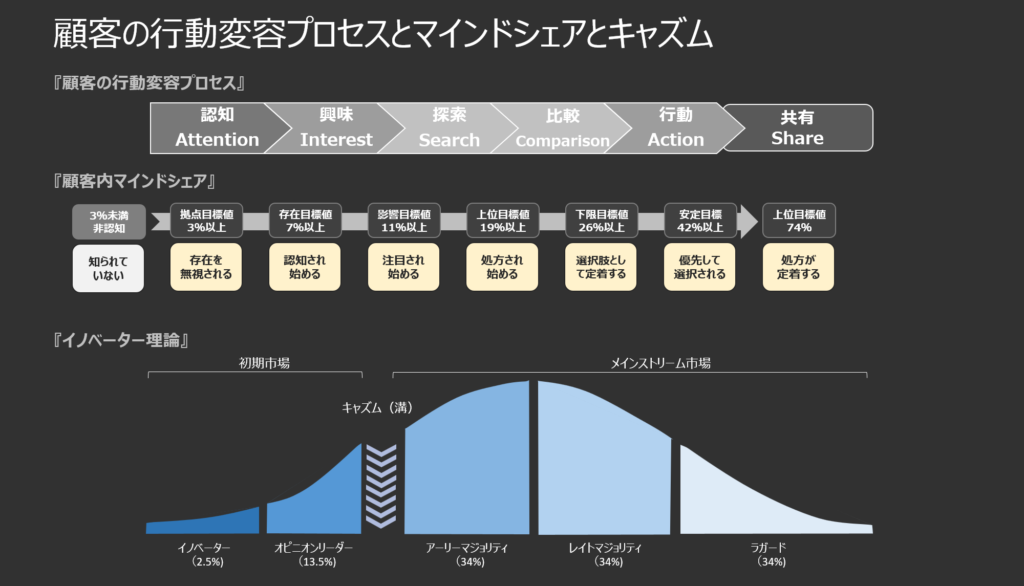
“Why is the new product launch stuck in a chasm and unable to break free?”
With a new product launch, a promotional campaign is rolled out, and the account openings seem to be going smoothly. However, it’s not uncommon to experience the frustration of seeing sales, which were initially expected to grow steadily, start to plateau.
This situation often arises when the account openings are tied to incentives for pharmaceutical wholesalers. One of the key contributing factors is the lack of customer focus. While the products are indeed delivered to customers, there is a notable absence of prescriptions being issued, and it is not unusual for returns to occur after a certain period.
The reason for this can be boiled down to one simple factor – while there may be quantitative recognition of customer profiles based on sales data, there is a failure to qualitatively understand customers through observation and subjective approaches that adapt to individual customer behavior changes.
Customers say they will prescribe if there is a suitable patient, the lack of a well-defined next step hampers the process of guiding behavioral change. As a result, the product ends up being prescribed mainly to highly motivated customers, while other potential customers are not sufficiently nurtured.
This challenge becomes even more pronounced in today’s business environment, where information channels have transitioned into digital platforms. Understanding customers’ behavior change, or in other words, their treatment preferences and prescription tendencies, is crucial based on the existing product’s status.
Even if the new product belongs to an entirely new class of medication, this principle applies if the target patients are already undergoing some form of treatment. Understanding customers’ treatment preferences and prescription tendencies, who are the physicians in this case, can be achieved through pharmaceutical sales data.
We show the customer mindshare value as a way to quantify the customer behavior change phase.