“Embracing the Unpredictable Future in the Present”
Those who remember the era before the post-war period of rapid economic growth are likely not actively engaged in today’s business landscape.
Referred to as VUCA, an acronym for “Volatility, Uncertainty, Complexity, and Ambiguity,” the concept describes a state of affairs where the future is opaque and predicting outcomes becomes challenging. We find ourselves standing in a business environment that none of us have experienced before.
The global uncertainty index over the past decade has escalated by a staggering 3.5 times.
A significant contributing factor to this shift is the contraction of markets due to worldwide economic downturns.
Consequently, our operating within a more fiercely competitive market has become the new norm.
Many of the business models we employ were conceptualized during periods of market expansion and might not align seamlessly with the landscape of competitive markets.
Rather than attempting to predict the future, the emphasis is on understanding the present circumstances and swiftly adapting to changes with flexibility and agility.
We are working on visualization to maximize the effectiveness of sales activities through sales support applications.
You can gain a competitive advantage by analyzing various data and visualizing it using digital technology.
Visualization makes it easier to grasp issues, and if the work flow is standardized, you can reduce costs by eliminating waste and reduce risks and mistakes.
Standardization creates a sense of unity in the organization and improves speed and quality without depending on individual skills.
let
Both “Mieruka” and “Kasika” mean making the invisible visible.
On the other hand, “visualization” means to make something visible, just like visualization, but it means to make something visible regardless of the person’s will.
Therefore, when arranging in the order that represents the state that is easier to recognize, it is “Mieruka” > “Kasika > “Sikakuka”
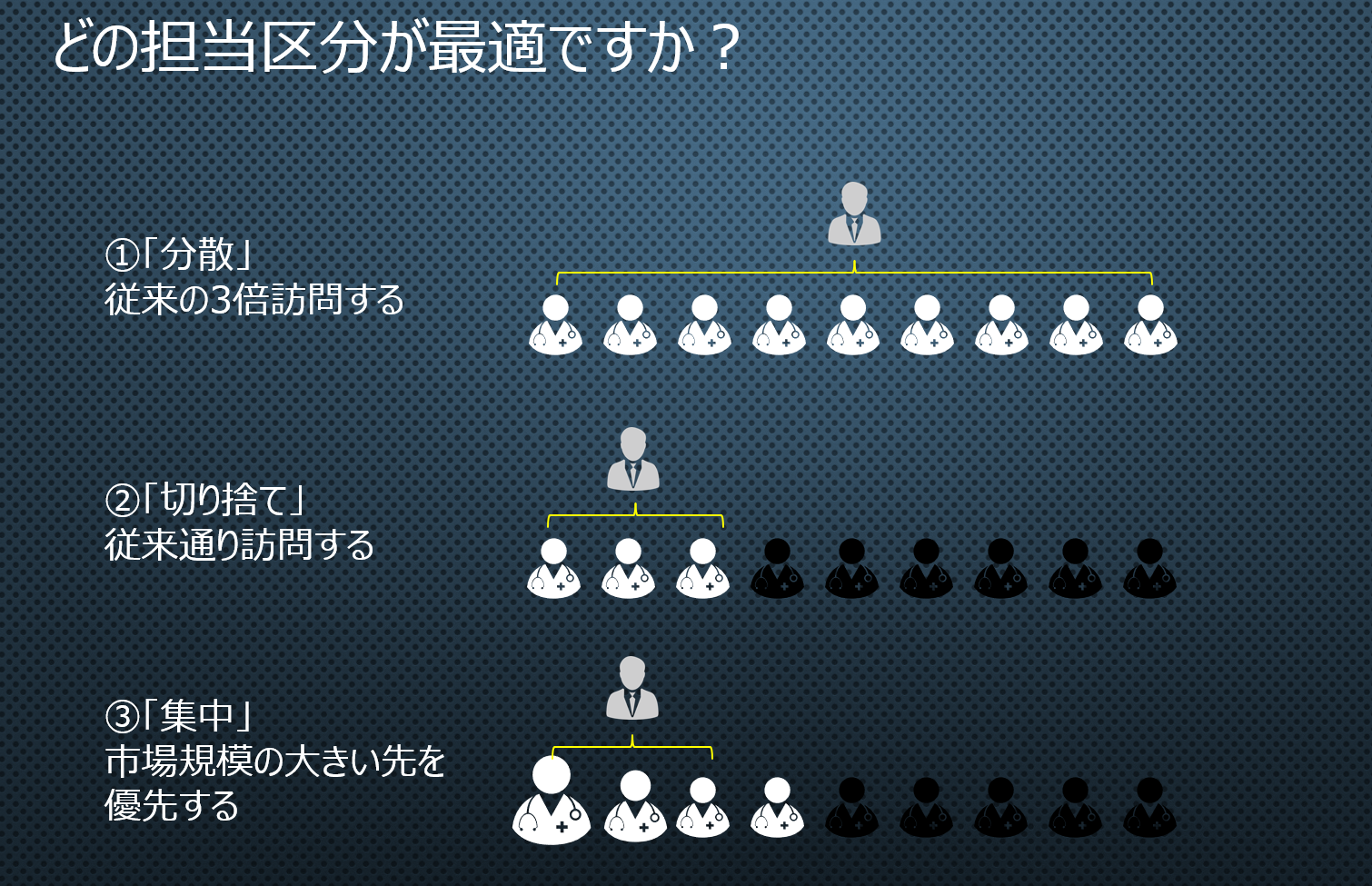
“How can we quantitatively and visually allocate personnel after reducing the number of MRs through early retirement or other means?“
There are several approaches to consider based on the objective:
Ensure that the remaining personnel cover all customers.
Exclude customers who would be left without an MR from the target list.
Prioritize reallocation based on the market size of customers.
Of course, the optimal solution depends on the specific objective.
If the purpose is to provide information about your company’s products, the remaining personnel should continue visiting all customers as before to provide the necessary information.
However, if the goal is to maintain current sales and further increase sales, none of the options 1 to 3 alone will suffice.
To maintain current sales and achieve further growth, the following actions are necessary:
Retain loyal customers of your company’s products.
Nurture customers who are evenly split between your company’s products and competing products into loyal customers of your company’s products.
Prevent customers who are evenly split between your company’s products and competing products from becoming loyal customers of the competition.
To accomplish the above, it is necessary to redistribute resources currently allocated to loyal customers of competing products and customers with low sales contribution to your company’s products and those in a competitive state. By using matrix analysis, options 1 to 3 can be quantified and visualized, while the resource requirements can be quantified using a force analysis method.
“Sequel: Alignment of Business Structure and Processes”
If the main focus is not given enough energy and only superficial issues are taken into account, management resources will be wasted. This is also true in business.
Originally, private companies exist to maximize profits, and all private companies should operate on the premise of bearing all responsibility for management under the free competition.
For pharmaceutical companies in the future, it has become an era where they cannot survive in the global competition unless they are companies that can survive in the midst of free competition.
Now, can the current pharmaceutical industry reform the essence of its stagnant business structure?
“In a hierarchical healthcare industry, just one customer has a market impact.”
The so-called “problem of conflict of interest”, is still fresh in our minds regarding doctor tried to promote specific drugs for endowed courses at Hiroshima University.
This is an example of the power of a single customer’s influence in a hierarchical organization.
The pharmaceutical business, which is targeted marketing, is fundamentally different from the consumer goods business, which extracts customers with a high probability of receiving orders.
Even if the customer rank is set low in the Pareto classification by market size.
It would be difficult for the head office to grasp the influence of such regional characteristics.
In the example shown in the slide, competitor product B, which has the lowest share in three products competition, has the highest competitive advantage.
Conversely, you can see that competitive product A, which has the highest market share, has a very weak competitive environment. The matrix analysis method can reveal vulnerabilities in a competitive environment that cannot be seen only by outward superiority or inferiority.
“Reasons #3 to urgently switch to a regional strategy”
If you only look at the overall market, you may misunderstand the competitive environment, and there is a danger that the sales reps will execute the wrong business plan.
If you only think about marketing, you tend to focus on “differentiation” from competing products.
But strategy is not just about differentiation.
In market share theory, there are four major strategies: “non-differentiation strategy”, “differentiation strategy”, “concentration strategy” and “niche strategy”.
You need to choose these four strategies correctly from the 3C perspective.
I will introduce an example of analysis using dummy data, using a competition between two parties as an example.
Suppose that the market share of competing products is 52% and the market share of your own product is 48%, and the competitive environment is in a state of rivalry.
According to the matrix analysis method, only 4.9% of customers are in the “competitive state” of your company, and the contribution rate to sales is only 4.8%.
Allocating all sales resources to this frame will not work, and 95% of the resources will be wasted.
On the other hand, for competing products, 12.2% of customers fall under the category of “competitive”, contributing 29.1% to sales, and occupying 23.8% of the total market, which is a large value compared to our company.
In other words, if competitor implement a differentiation strategy in the same way as your company, the effect will be overwhelmingly large.
Your company’s loyal customer rate is 34.1%, and the contribution rate to sales is extremely high at 75.4%.
Maintaining this frame will lead to stable sales, so the non-differentiation strategy lead to nullify the differentiation strategy from competing products.
A strategy must be chosen correctly according to its purpose.
Anyone can easily analyze and plan the matrix analysis method, and it is a very effective tool for area marketing.
“Reasons #2 to urgently switch to a regional strategy”
In many companies, it is a enhancement type that adds a new method using digital instead of conversion while keeping the conventional strategy plan / marketing plan method as it is.
What is really required, however, is a fundamental shift in strategy.
As the market shrinks, conventional strategic plans/marketing plans will be forced to change.
Even in Ansoff’s growth matrix, which is used as a textbook, “market penetration” is the frame of the growth strategy during the period of market contraction.
You will give top priority to maintaining existing customers, win over competition in a shrinking market, and expand your market share.
Business expansion and unreasonable diversification will dilute the brand image of the company, and the sameness that makes it difficult to differentiate will progress further.
The matrix analysis method can realize quantitative and visual strategy planning from the viewpoint of 3C.